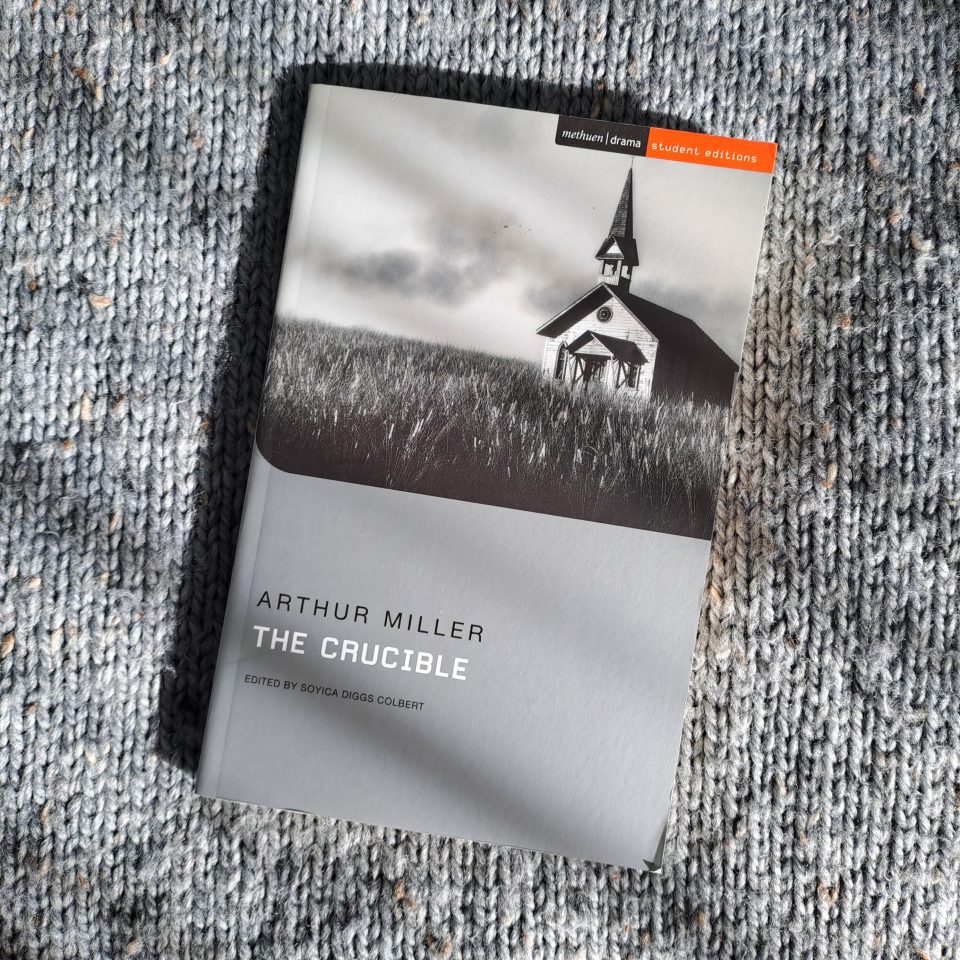
The Crucible is the last of Arthur Miller’s ‘big hitters’ for me to read. I first studied Death of a Salesman for my A Levels and loved it. It stayed with me during my undergraduate degree, and I revisited it for my Masters. My dissertation took a deep dive back into Death of a Salesman, and my wider research covered All My Sons and A View From the Bridge. I have long since told myself I must read The Crucible to get the full scope of his most successful works.
I am definitely feeling myself being drawn back towards revisiting some classics. BookTok is having a huge influence of encouraging readers to pick up classics. I recently ordered a copy of John Steinbeck’s East of Eden, and that got me thinking about The Crucible again. I chose this edition specifically for the introduction and notes surrounding themes and historical context, which I read after reading the play itself.
The Crucible
The Crucible centres around the Salem witch trials of 1692. A small farming community is quickly swept up in gossip and hysteria with rumours of witchcraft and devil worshipping. A group of teenage girls is found dancing naked in the woods at night, after which several are taken ill. Cries of witchcraft are at first stifled, but then quickly spread. To avoid suspicion, distract, deflect and pass blame, a stream of ‘confessions’ of villagers having the devil inside them pours forth. Neighbourly grievances, jealousy and religious piety become a breeding ground for suspicion and accusation. The consequences are severe and deadly.
I was gripped reading The Crucible. It is a short play, with simple dialogue, and yet the fervour, fear and frenzy is so palpable. Going into it, I had to remind myself just how puritanical and strict the religious views were. It might be easy for us to read the hysteria as far-fetched with our modern gaze, but people were completely terrified of the devil, of going to hell, and of being hanged. The church and the courts could wield tyrannical power. This feeds deeply into the back and forth of accusations, lies and miscarriages of justice, as innocent people strive for their truth to be heard against the dire consequences of being found guilty.
Give me more!
I would love to study the play in more detail! Arthur Miller plays always bring this out in me! I need lectures and seminars and someone far more knowledgeable feeding me information while I scribble notes.
I wanted to take a deep dive into so many of the characters and what they represent. It is a play where every single character has vital importance and serves an integral role. Arthur Miller really is so masterful at this. Sometimes just the smallest of comments made by small part characters have huge consequences for others.
There is also a really interesting gender dynamic that I hadn’t anticipated. The group of teenage girls hold so much sway over the men in power. Even in the face of being duped, their fragile masculinity and relationship with power makes many of them double down on their convictions. I didn’t personally interpret Abigail as a femme fatale as the notes suggest she has been. However, we learn about John Proctor’s adultery, and I’d be easily convinced at Reverend Parris being in the woods to glimpse her naked dancing. Rumours of her later prostitution are perhaps a signal from Miller of her overt sexuality and eventual downfall.
Another detail that I really appreciated, is the consequence of these trials on village life in Salem. With so many men and women hung or imprisoned, we hear of orphaned children, cows wandering loose, desolate farmland and rotting, failing crops.
Crucial and contemporary
The Crucible is a sobering read, and still translates so well to the present day. At the time of writing, Arthur Miller was drawing parallels with McCarthyism. Now, more than 75 years on, the political landscape of the US and the current witch hunt of migrants by ICE shows how dangerous collective misinformed hysteria can be to the victims of scapegoating. The Crucible alludes to riots, unrest and a turn from favour in nearby towns and villages, as people push back against the accusations. We are currently seeing this played out in the protests in Minnesota. I can’t help but think that Arthur Miller would have written something incredibly searing about it.